

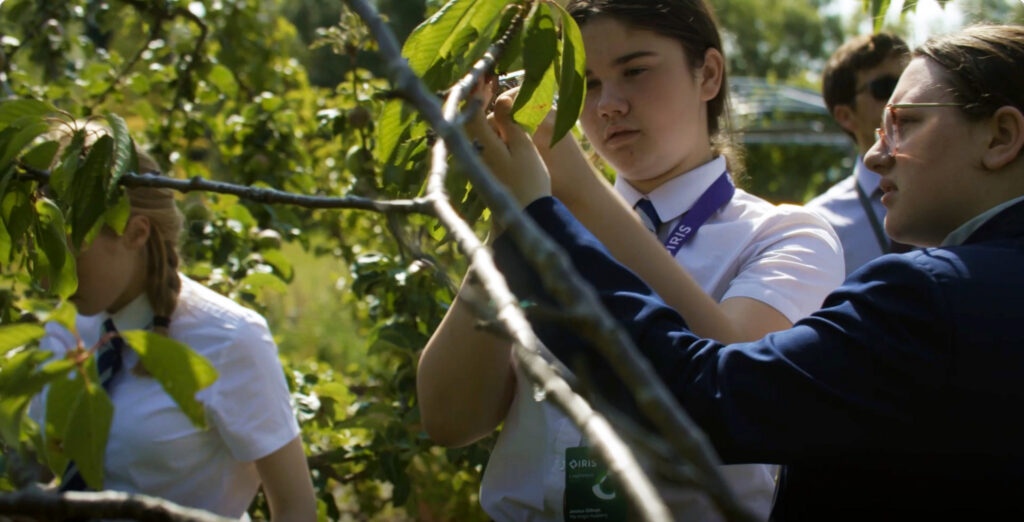
Student-led research builds skills for life. Our new skills tracker shows the technical and transferable skills that students can gain across each IRIS project.
Young people are stepping into a world shaped by rapid technological innovation, the response to climate change and geopolitical uncertainties. These changes will bring new roles and opportunities in the job market, and young people will need to have the technical and transferable skills to adapt and thrive.
We’ve created a tracker to show teachers the key skills that students can expect to use and develop in each IRIS project as well as how they can help schools attain the Gatsby benchmarks. The tracker incorporates the eight essential skills from Skills Builder’s Universal Framework launched in 2020 and the Innovation Skills Framework, commissioned by Innovate UK to support the next generation of entrepreneurs and innovators.
From our own teaching experiences, we understand the pressures, competing priorities and accountability requirements in schools. If you’re thinking about starting an IRIS project, this skills tracker will help you decide which project might be best for your students. It’s a resource to take to your school leadership team (SLT), showing what the benefits of a project are likely to be for your students and the school. It also helps you to communicate the value of the work you do in supporting student-led research to others beyond your school. View the skills tracker here.
Sitting alongside the curriculum, IRIS projects foster a whole range of skills by immersing students in authentic, sustained research experiences. We know they do this because we consistently evaluate the impact they have on young people’s perceptions of their abilities. In 2025, we surveyed 639 students after they had taken part in an IRIS project. 89.2% of students felt that their research skills had improved, with the largest improvements in finding information and information literacy (evaluating and analysing information), followed by formulating questions and time management.
“It was a great experience to develop my research skills and be part of a team. I formed new friendships in my school and developed a better relationship with my teacher. [I found] resilience to keep going when our experiments were unsuccessful and [learned] how real scientific research is carried out. I’m now interested in a research-based career.”
Year 13 female student
We also tracked the eight essential skills from Skills Builder. We found statistically significant improvements in the transferrable skills of students who took part in a project, particularly adapting, leadership and teamwork. Most students who had carried out a project went on to rate these skills as good or very good, including speaking (84.6%), listening (84.0%), planning (81.6%), creativity (79.6%), problem-solving (78.0%) and teamwork (72.8%). A male student in Year 10 told us: “It has allowed me to be more independent and has made a difference to how I approach a problem.” Another Year 13 female reflected: “It helped me get closer to my peers. It taught me how to deal with setbacks and overcome challenges my group faced in our project.”
Without the chance to apply what they have learnt to real questions, students often don’t develop the capabilities they need to excel in STEM after school. Student-led research projects deliver and consolidate knowledge but also build skills in ways that the curriculum alone cannot. Critical thinking, teamwork and resilience can’t be learnt out of context. IRIS projects provide the context: Students apply themselves to real problems that mirror how STEM works in the wider world.
“Research is unlike school practicals, there are continuous fails. You have to learn from the mistakes and move on.”
Year 12 male student
Learning STEM subjects at school isn’t just about passing exams. It’s about being prepared for the work of tomorrow—including employment, with all the innovations and challenges they will encounter. An IRIS project is an opportunity for young people to practice and develop the skills they will need.
We believe that all young people should have these opportunities, which will serve them for life.
Case study 1: Wild Things
This project is for students aged 11 and over. In one school, students on the project looked at whether bug hotels could help increase biodiversity around their school. They designed an experiment to explore this, using pitfall traps to count insects as well as a control site for contrast. Their initial pitfall traps were not very effective, leading them to test out a range of materials that could help them gather meaningful data. Although their experiment showed mixed results, it allowed them to use critical thinking and problem-solving as well as practise evidence gathering. They also developed teamwork, communication skills, resilience and motivation to find answers to the questions throughout the project.
“We’ve seen [students] actually developing some useful social skills as well as the overall learning about research and the impact that it can have. Because it is broad, because you can do it with small groups, because you can allow students to have a bit of free reign over which way they want to go… It was a really natural skill development, which I thought was really, really impressive.”
Teacher delivering Wild Things in 2024/25
Case study 2: Original Research
Original Research is undertaken by students who already have their own burning questions to develop, explore and perhaps even answer. Two groups of young people in a Northern Irish school looked at reducing pollution in Lough Neagh, the largest lake in the United Kingdom and source of 40% of local drinking water. Toxic blue-green algae have flourished in the lough because of fertiliser run-off from surrounding fields. Forcefully removing the algae would release toxins into the environment, so students looked at other avenues. One of the student groups tested hydroponics—floating crops—as a way of absorbing pollution. They grew garlic in water tanks that replicated the lough’s conditions and observed positive results in phosphate reduction, paving the way to look at other plants and scaling up.
The students developed their own research question and methods and then put their hypothesis to the test. This involved scientific skills such as identifying common control variables as well as methods to measure phosphate levels in the water. Transferable skills put into practice included creativity, communication and effective collaboration. Because of the success of both student projects undertaken in academic year 2024-25, the school has now established a link with Queens University Belfast, which is feeding into the current projects being carried out in 2025-26 to continue to investigate approaches to address the problems in Lough Neagh. In our evaluation for the 2024/25 academic year, students consistently raised skills growth. A female student in year 12 said: “It didn’t just teach me about science; it also taught me about teamwork and how to pose and create my own research questions.”
“I learnt about valuable life skills like time management, selective data manipulation, reading and understanding complex articles and research.”
Year 10 female student