

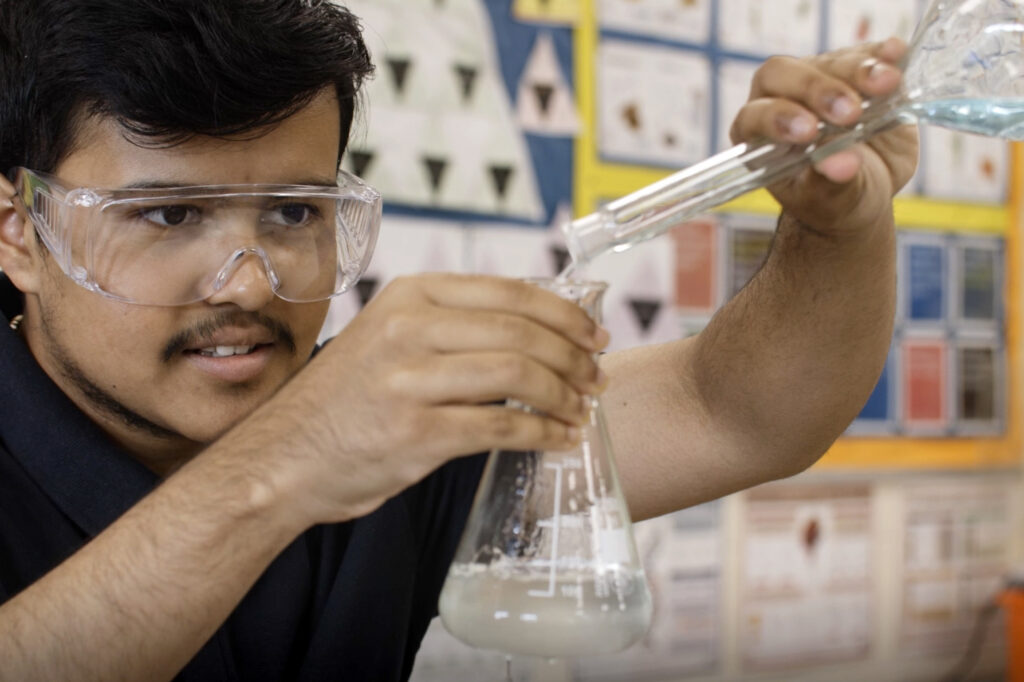
This is an extract based on an original article by the Institute for Research in Schools’ Director and Deputy Director, featured in Science in Parliament magazine. IRIS has experience of working with over 10,000 students and brings research and innovation (R&I) into classrooms across the UK. This second part in our three-part series reflects on IRIS’ experience of student-led research and the potential this has to meet STEM industry skills need. We see students’ confidence in and understanding of Science, Technology, Engineering and Maths (STEM) grow beyond the curriculum.
Dr Jo Foster, Director of the Institute for Research in Schools and
Marcus Bernard, Deputy Director of the Institute for Research in Schools
Bringing R&I into the classroom of over 10,000 students.
What if young people experienced science not simply as knowledge, but as something they could do? This is the premise behind the Institute for Research in Schools (IRIS), a national charity delivering student-led research projects in schools across the UK. For a decade, we have worked with over 10,000 young people, supporting them to ask genuine questions, investigate questions scientifically and communicate what they discover. Our mission is to change the culture in UK education so that every young person experiences real research.
Student-led research lets young people experience the research process from beginning to end. Rather than following instructions to reproduce a known result, they formulate questions, develop methods, collect and analyse evidence, interpret findings and consider what should happen next. Research builds on curriculum knowledge while changing how students use it: they apply what they know to unfamiliar problems, developing scientific skills alongside creativity, communication, collaboration and the confidence to work with uncertainty—qualities central to research and innovation in the wider world.
Learning beyond the classroom
Projects can take young people’s interests far beyond the classroom. Last year, one student combined mountain climbing with artificial intelligence to explore whether AI could identify people needing rescue in snow. The project brought together a personal interest, an emerging technology and a real-world search-and-rescue challenge.
Other projects tackle challenges affecting students’ communities. At a school in Northern Ireland, students investigated ways to reduce phosphate pollution in Lough Neagh, testing whether hydroponically grown garlic could absorb phosphate from polluted water. They designed the experiment, created conditions to replicate the lough, measured phosphate levels and observed promising reductions. Following the project’s success in 2024–25, the school linked with Queen’s University Belfast, whose researchers were supporting further student-led investigations.
Greater interest in STEM careers
These projects show what success can look like when young people are given the opportunity to participate in real science. Ten years of evaluation suggest benefits beyond STEM knowledge. Across our programmes, 85% of students reported improved knowledge of STEM careers, 76% greater interest in STEM careers and 90% increased self-belief. Around three-quarters said they are more likely to identify with researchers or people working in STEM.
76%
of students reported a greater interest in STEM careers
(IRIS outcome measures 2018-2025)
IRIS is part of a growing national movement of organisations bringing authentic research into schools, with young people collecting and analysing real data and working with universities and research institutions. Together, this work points towards a different relationship between schools and the research and innovation system: schools become places where young people participate in science, not simply prepare for it.
Authentic research gives students experience of being scientists: asking questions, dealing with uncertainty, working with evidence and creating knowledge. The policy challenge is to make these opportunities available to more young people, rather than leaving it to only the schools and students who have access today.
 SUBSCRIBE TO OUR NEWSLETTER
Interested in what we do, and want to find out more?
 IMPACT REPORT
Read our latest impact report.
Adapted from IRIS' article published in Science in Parliament, shared with permission of the Parliamentary & Scientific Committee.